Japan / Bizen Province · Medieval Japan · Bizen Osafune · Bizen Ware
Bizen Province, Part II — Markets, Ports, Swords, and Clay
Medieval Bizen was more than warfare: the market at Fukuoka, the port of Ushimado, Osafune swords, and Inbe pottery made a country in motion.
In Part I, the provincial capital and San’yō road connected Bizen to the ancient state. In the medieval period, that order did not disappear. It was rearranged into overlapping networks of estates, warriors, markets, and ports.
New Warriors, Overlapping Powers
Many coastal magnates had been tied to the Taira. After their defeat, eastern warriors entered Bizen as estate stewards rewarded by the victorious side. Families such as the Sasaki, Nagai, and Matsuda became new agents of territorial rule.
The shogunate’s constable, estate proprietors, and local warriors could hold different rights in the same land. Medieval Bizen was not governed from above by a single hand. It was a country of intersecting powers.
The Market at Fukuoka
Fukuoka on the Yoshii River became a political and economic center. A provincial headquarters probably stood there, while its periodic market gathered farm products, crafts, and goods carried from a distance.
The famous scene in the illustrated biography of the monk Ippen shows a dense public world of merchants, customers, and carriers. A country’s center was not only its fortress. A marketplace where prices were made and information exchanged also generated power.
The Yoshii River joined the interior to the Inland Sea. Swords made at Osafune, agricultural tools, and pottery all entered wider circulation through rivers and roads.
Ushimado, the Maritime Gate
Ushimado was an important port on the Inland Sea. Vessels waited for tide and wind, exchanged cargo, and carried people toward the Kinai, Kyushu, and the Asian continent. After warfare damaged Hyōgo, Ushimado at times served ships involved in trade with Ming China.
The sea was not Bizen’s edge. Shōdoshima belonged to Bizen into the medieval period, evidence that regional life extended across water. Religion, culture, and political intelligence traveled with sailors and cargo.
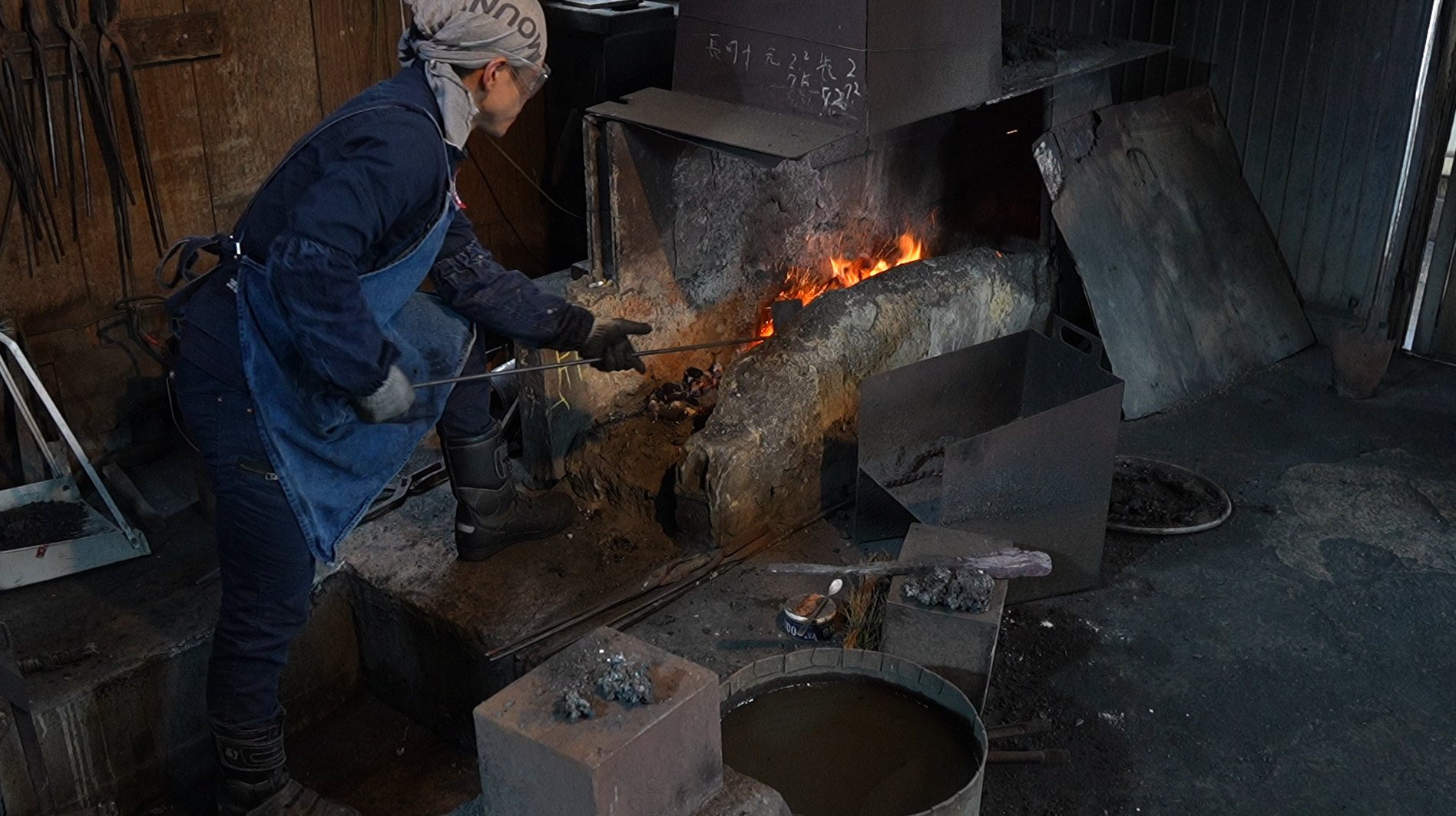
The Swords of Osafune
Osafune possessed a rare combination: iron sand from the Chūgoku mountains, woodland for charcoal, water, and access to the San’yō highway and maritime routes. The Fukuoka Ichimonji school flourished in the Kamakura period, and the Osafune tradition later produced generations of renowned smiths.
A Bizen sword was both a weapon and a high-value commodity created by specialization and long-distance markets. Behind a named master stood people who gathered iron, made charcoal, forged and polished blades, fitted mountings, and transported finished work. A celebrated sword was the product of a regional society.
The Clay of Inbe
Bizen ware also expanded through medieval distribution. High-fired without applied glaze, its jars, storage vessels, and mortars were durable tools carried across western Japan.
Later appreciation in the tea ceremony should not obscure this practical foundation. Bizen kilns survived by answering ordinary needs: storage, transport, and food preparation.
Swords and pottery were different industries, yet each controlled fire and placed regional resources into broad circulation. The name Bizen traveled across Japan inscribed in products before it became a modern brand.
From Constables to a Territorial Lord
From the fourteenth century, the Akamatsu of Harima held Bizen’s constableship, with the Uragami and Matsuda administering its eastern and western parts. The Akamatsu collapse in the Kakitsu Incident of 1441 opened the province to Yamana expansion and renewed conflict.
The Uragami then rose from Mitsuishi Castle. Ukita Naoie, originally their retainer, overcame the Uragami, Matsuda, and neighboring powers and emerged as a territorial lord centered on Bizen.
Naoie’s success cannot be explained by intrigue alone. He connected castles to markets, ports, and the Yoshii River corridor, gathering dispersed power into a new center. Around 1573 he moved his base to Okayama. The focus of Bizen began to shift from Fukuoka’s market to a castle town capable of drawing roads and merchants toward itself.
Continue to Part III: “Okayama Castle and the Ikeda House.”
Sources and Image Credits
- Setouchi City, Osafune and Bizen swords
- Okayama City, castles of Ukita Naoie
- Okayama City, reassessing the Ukita
- Entries on Bizen Province in major Japanese encyclopedias, accessed through material supplied by the user.