Japan / Shizutani · Shizutani School · Bizen City · Education
Shizutani — The Valley a School Remade
The Former Shizutani School was not merely built in a valley. It gave the place a name and reorganized its fields, village, kiln, shrines, and forests around education.
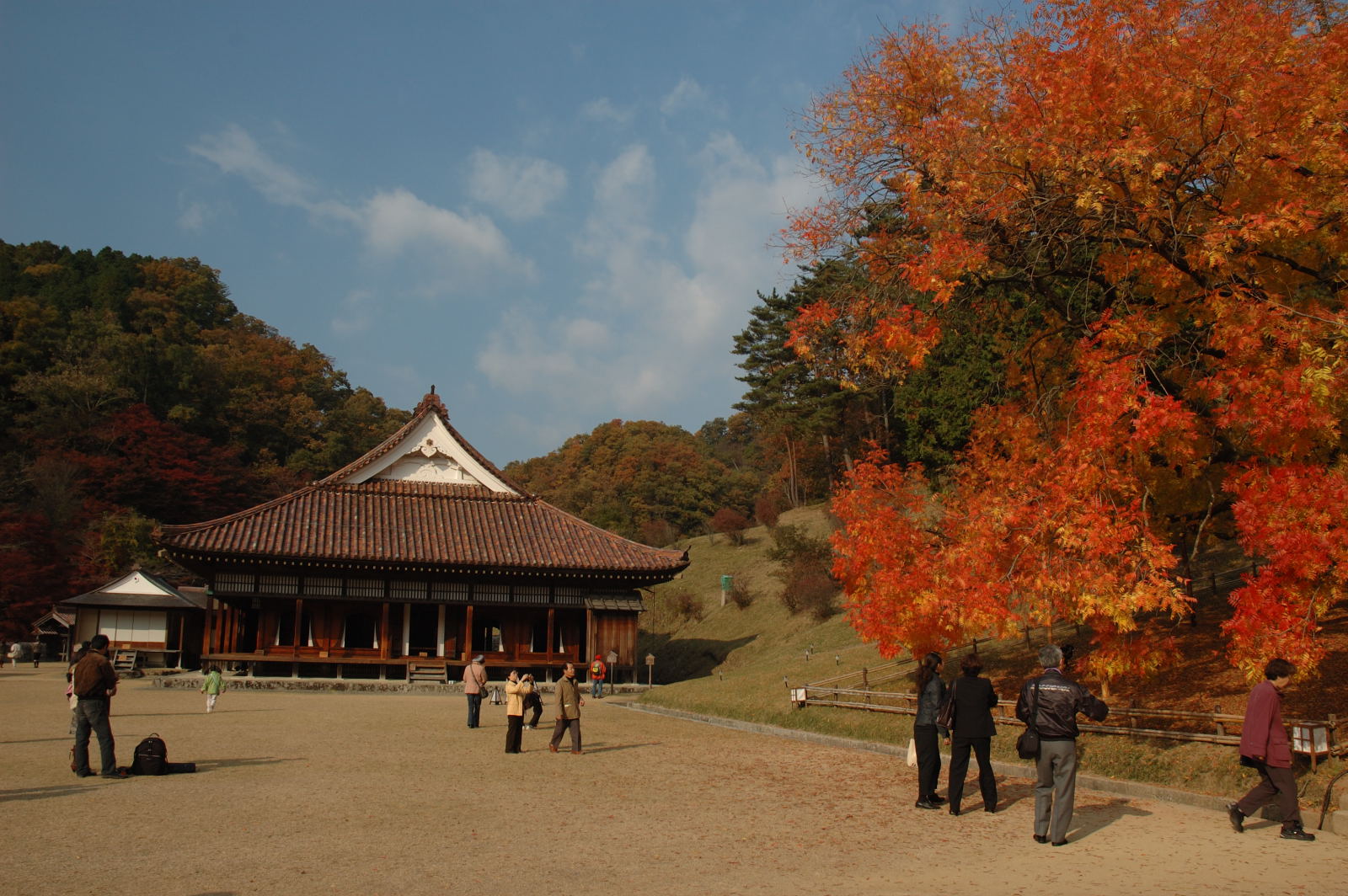
In the north of Bizen City, where the Iri River begins, lies a place called Shizutani.
Fields and houses occupy a narrow valley floor enclosed by mountains. At their center stands the Former Shizutani School, whose lecture hall is a National Treasure. Today, the name Shizutani immediately evokes the school.
But Shizutani is more than the place where a school happened to be built.
The school gave the valley its name. Fields were reorganized, residents moved, and a new village created. A kiln, shrines, farmland, and woodland were arranged as parts of a landscape intended to sustain education over time.
The history of Shizutani is therefore not simply the history of one school. It is the history of education remaking an entire valley.
Before the Valley Was Called Shizutani
In the early Edo period, the area was part of Kitani village in Wake district, Bizen Province, and was known as Nobuhara.
Ikeda Mitsumasa, lord of the Okayama domain, visited in 1666. Enclosed by mountains and distant from the noise of ordinary life, it appeared to him an ideal setting for study.
The school’s official history records his description of the place as one of clear, quiet mountains and water, suitable for reading and teaching. In 1670, Mitsumasa ordered his retainer Tsuda Nagatada to establish a school for commoners there. Nobuhara was renamed “Shizutani,” the quiet valley.
The place-name was not an ancient inheritance. A school was located there because the valley was quiet; once the school was established, that quietness became the name of the land.
A School Cannot Survive as a Building Alone
Mitsumasa wanted more than a lecture hall.
For a school to last decades or centuries, teachers and students must be supported, buildings repaired, and food, fuel, and timber secured. A school dependent on each change in the domain’s finances or its ruler’s preferences could not carry his purpose into another generation.
Tsuda Nagatada addressed this problem. He developed a system in which the school became, in effect, a landholder. Revenue from fields and woodland supported its operation. Land in Kitani village became school territory, and educational fields were organized to finance the institution.
Rice came from the paddies; timber and fuel came from the hills. By joining the productivity of land to the finances of learning, the domain attempted to make education permanent.
The National Treasure hall alone cannot explain Shizutani. Its paddies, forests, waterways, and settlement were also parts of the institution.
How a School Remade a Village
The school estate was not built upon empty land. People already lived there.
Regional historical records state that residents of the original Kitani village received replacement fields elsewhere in the district and moved away. Sixty-three tenant households were then brought in to cultivate the school’s land. The settlement came to be known as Shizutani Shinden, or Shizutani New Fields.
This is why Shizutani cannot be described only through a beautiful educational ideal.
The system intended to preserve the school changed landholding and residence. Creating a place of learning required some people to move and gave others a new place to live and work. What Mitsumasa and Nagatada saw as an ideal site for study was also a landscape in which lives were reorganized by policy.
Education required land and labor as well as conviction. That material reality belongs within the history of Shizutani.
Drawing an Ancient Ideal in Rice Fields
Fields known as the seiden were also developed around Shizutani.
The name refers to the well-field system described in Confucian texts as an institution of ancient Zhou China. Land was imagined as nine divisions resembling the character for “well”: eight plots cultivated individually around a central plot worked in common.
Mitsumasa did not wish to leave Confucian thought inside books. He instructed Nagatada to give the idea a physical form in the land.
The surviving fields are not a complete reproduction of an ancient Chinese system. Yet the attempt to make political philosophy visible as agricultural geometry reveals something essential about Mitsumasa’s government. At Shizutani, Confucianism was taught in the classroom while the landscape itself was conceived as a model of Confucian order.
Tiles Fired in the Valley
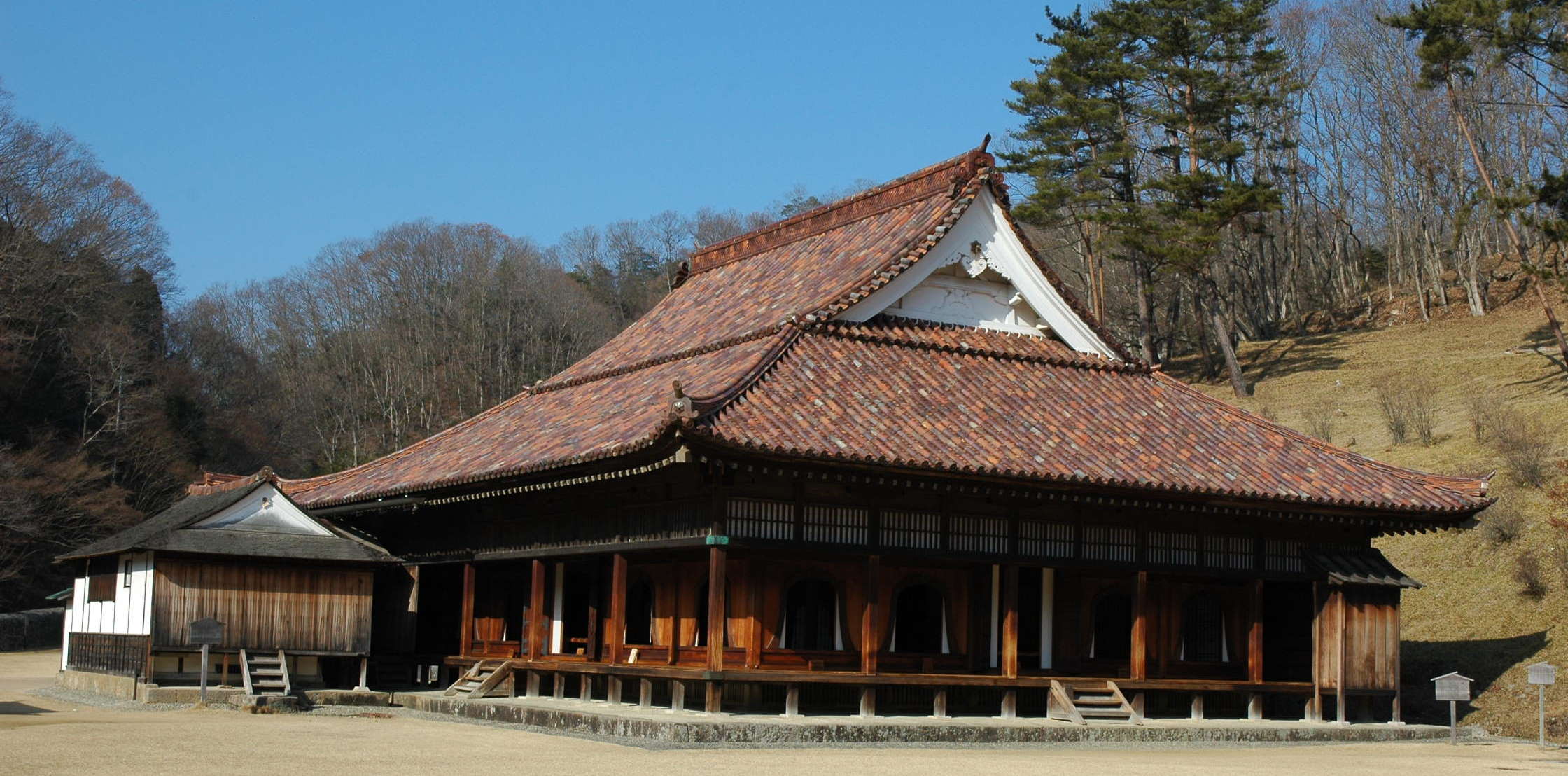
The buildings at Shizutani are roofed with Bizen-ware tiles.
Nagatada established a kiln near the school and brought potters from Inbe to produce them. Durable Bizen tiles were used on the Confucian sanctuary, Shizutani Shrine, and the lecture hall.
The kiln made more than roofing. Ritual vessels and smaller objects were produced there, and ceramics made at the site became known as Shizutani ware.
Where the kilns of Inbe produced jars, storage vessels, and mortars for broad commercial distribution, the Shizutani kiln was closely bound to school construction and domain projects. An Okayama Prefecture account describes it as a site resembling an experimental kiln for the domain.
The tiles did more than keep out the rain. Local materials and skilled labor turned the idea of enduring education into a physical structure.

Shrines Within the Educational Landscape
Fuku Shrine stands in Shizutani apart from the school grounds. Long revered as the local tutelary shrine, it was moved and rebuilt at its present site under Ikeda Tsunamasa, Mitsumasa’s successor.
Inside the school complex, Hōretsushi was built in 1686 to enshrine Mitsumasa. His grandfather Ikeda Terumasa and father Ikeda Toshitaka were added in the Meiji period, and the sanctuary became today’s Shizutani Shrine.
Confucius was enshrined in the sanctuary, while the domain lord was honored immediately to its east. Placing the founder of learning beside the founder of the school reveals how education and government remained inseparable at Shizutani. Study served the individual, but it also supported the ethics and order of the domain.
A School That Returned After Closing
Shizutani did not continue unchanged from the Edo period to the present.
The school closed in 1870 during domain reforms. It reopened as Shizutani Seisha in 1873 with the participation of Yamada Hōkoku, closed again, and returned as Shizutani Kō in 1884.
Its institutional name and structure changed repeatedly: a private middle school, Okayama Prefectural Shizutani Middle School, Shizutani High School, and then the Shizutani campus of Wake High School.
When that campus closed in 1964, the historic site ceased to function as an ordinary school building. The following year, a prefectural youth education center opened there, giving the valley a new role in training and social education.
Education at Shizutani did not move along an unbroken line. It closed, revived, changed institutions, and passed into new hands. Each generation gave new educational meaning to old buildings.
From Shizutani Shinden to Shizutani
From the Edo period through the early Meiji era, the village was called Shizutani Shinden.
After the municipal system was introduced in 1889, it became a district of Iri village, later passing through Iri Town and Bizen Town. In 1961, “Shinden” was removed and the place became simply Shizutani. When Bizen City was formed in 1971, it became a district of the city.
The word “new fields” has vanished from the modern address. The history it described has not. Field divisions, settlement patterns, and the woods around the school still preserve the memory of a period when agriculture and education formed a single institution.
A Quietness Made by More Than Nature
The first thing many visitors notice at Shizutani is its quietness.
Mountains absorb the sound. Inside the stone wall, buildings stand in controlled order. The polished floor, Bizen-tiled roofs, and axis leading toward the Confucian sanctuary appear almost native to the valley.
Yet this landscape was not simply preserved in a natural state.
The valley was selected and named for a school. Fields were organized to support it. Residents moved and new cultivators arrived. A kiln was built, tiles were fired, and shrines and memorial sites were placed in relation to the institution.
The quiet of Shizutani is both natural silence and a silence produced by policy and labor.
The World Required to Sustain One School
Seen as architecture, the Former Shizutani School is a cultural property. Seen from the perspective of the place, the school was the organizing center of an entire valley.
Learning took place in the hall. Fields financed it. Forests supplied materials and fuel. A kiln fired its tiles. Villagers cultivated its land. Shrines honored the local deity and the lord who founded the institution. Their connection allowed the school to survive its creator.
Education does not exist inside a classroom alone. It requires resources to maintain buildings, land that produces food, people whose work sustains it, and a community that carries the institution forward.
Shizutani is not merely a valley containing a school. It is a place where, to preserve one school, the valley itself became part of the school.
Sources and Image Credits
- Former Shizutani School, historic-site overview
- Bizen City, history of the Former Shizutani School
- Bizen City e-Bizen Museum, Tsuda Nagatada
- Bizen City e-Bizen Museum, the National Treasure lecture hall
- Okayama Prefecture, archaeological report on the Former Shizutani School
- The entry on Shizutani in the Nihon Rekishi Chimei Taikei, accessed through reference material supplied by the user.
- Lead image: the Former Shizutani School in autumn. Photograph by Reggaeman, CC BY-SA 3.0.
