Japan / Bizen City · Shrines · Katakami · Bizen Ware
Usa Hachimangu in Katakami――Memory from the Sea, Guardians of Clay
A storm-bound legend, monumental Bizen-ware guardian lions, and festivals through which Katakami assumes its history.
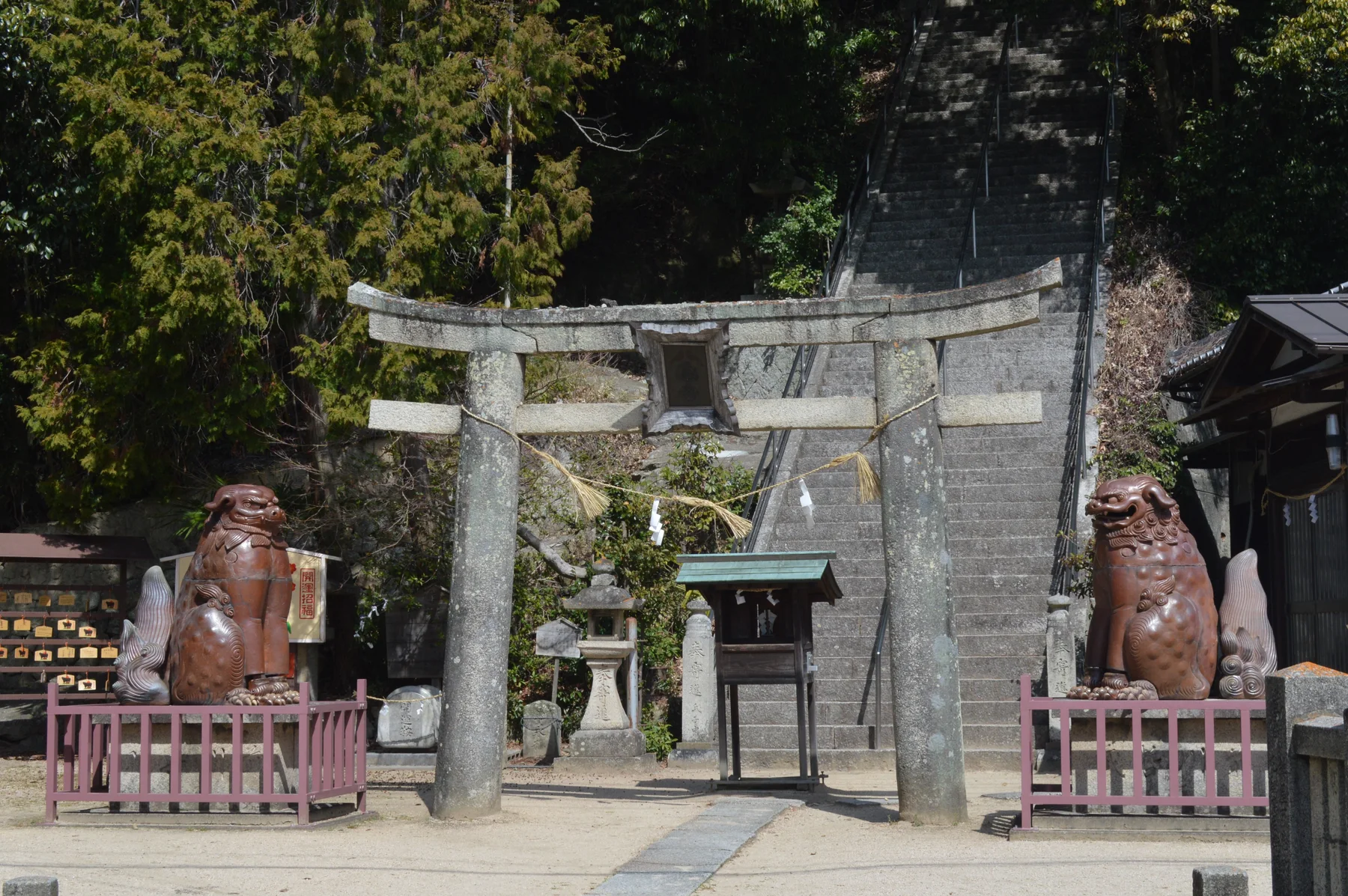
The sea is a road and, at the same time, a refusal. It carries people, then sometimes denies their passage. The tradition of Usa Hachimangu in Nishikatakami begins in this double condition.
The Association of Shinto Shrines in Okayama Prefecture dates its foundation to 1336. According to its account, Ashikaga Takauji sought to bring the deity of Usa Hachimangu in Buzen eastward while returning to Kyoto. A violent storm stopped the journey, and the deity was enshrined in what is now Katakami. The shrine was moved to a mountaintop in 1394 and to its present site in 1646. Emperor Chūai, Emperor Ōjin, and Empress Jingū are worshipped here.
At the center of the story is not only a warrior’s victory. There is also an intention interrupted by the sea, and an interruption that produced a place. History is not the straight line of a plan. Contingency makes people stop; when they give that stopping meaning, a place acquires memory.
Monumental guardians made of earth
Beside the torii stand large Bizen-ware guardian lions. Inscribed with the year 1826, they measure about 1.4 meters high and 2.5 meters around the body. Designated cultural properties of Bizen City, they rank among the largest Bizen ceramic works of their kind in Okayama Prefecture.
Guardian lions are often carved in stone or wood. In Katakami, however, the local ceramic tradition was given the form of a sentinel. Soft clay hardened in the kiln and became a watching body. Matter appears passive, yet acquires a role through human purpose. It does not entirely erase the fire: intention and the contingency entrusted to flame remain together on its surface.
The lions guard more than buildings. They guard ceramic knowledge, the community that could make such an offering, and the accumulated gaze of those who have looked up at them for two centuries.
A festival remakes the town
The shrine serves the districts of East and West Katakami. Its spring festival includes floats, a children’s procession, and portable shrines; an autumn festival is also maintained.
A community does not exist merely because people occupy the same ground. It appears when they choose one another as “we” through action. Pulling a float, forming a procession, and handing roles to children are bodily repetitions of that choice.
Tradition is not good without condition. Every inheritance demands judgment: what to preserve, who may participate, and how much change to admit. Even refusing change is a choice made by people in the present.
A place born from interruption
Usa Hachimangu layers a maritime legend, warrior memory, Bizen ware, and Katakami’s festivals inside one precinct. They did not begin in the same century. Meanings added later coexist with those already present.
The shrine is therefore not a seamless picture of history. It is a depth made by different generations inscribing their present. A voyage stopped by the sea became a story of local origin. Clay became guardians at a boundary. Festival temporarily turns a town into one body.
We cannot choose our past. We must nevertheless choose the position we take toward it. Usa Hachimangu is a place where that choice has acquired form.
Sources and Image Credit
- Association of Shinto Shrines in Okayama Prefecture: Usa Hachimangu
- Bizen City: Japan Heritage—The Six Ancient Kilns
- Lead image: Usa Hachimangu in Nishikatakami. Photograph by Asturio Cantabrio, Wikimedia Commons, CC BY-SA 4.0. Original cropped and resized.
