Japan / Bizen City · Shrines · Bizen Ware · Inbe
Amatsu Shrine――Where a Town of Clay and Fire Enshrines Itself
In Inbe, the home of Bizen ware, ceramic tiles and offerings reveal how industry and belief grew from the same earth.
A shrine is not a box in which the past is preserved. It is a place where people repeatedly choose, in the present tense, their relationship with the land.
At Amatsu Shrine in Inbe, Bizen City, that relationship has the color of earth. Bizen ceramic tiles cover the gate roofs, while offerings made by kilns and potters stand along the approach. Here pottery is more than merchandise. It has become a language in which a community presents itself before the sacred.
The tutelary shrine of Inbe
According to the Association of Shinto Shrines in Okayama Prefecture, oral tradition dates the shrine’s foundation to 1411. Sukunahikona no Mikoto was worshipped first, and Sugawara no Michizane was later added. Ame no Futodama no Mikoto and Ōnamuchi no Mikoto are also among its enshrined deities today.
The sanctuary originally stood in Ura-Inbe. Tradition holds that after an epidemic struck Inbe, it was moved to its present site in 1579. The existing main sanctuary was rebuilt in 1678. Local worship has associated the shrine with recovery from illness, learning, and prosperity in the ceramic trade.
Such an origin is not made only of facts that modern historiography can prove. The account of disease and divine instruction is also the memory of people giving meaning and sequence to a crisis. Human beings do not choose disaster. They do choose how to assume it as a story. Repeated across generations, that choice gives a community its outline.
When clay becomes the surface of belief
What distinguishes Amatsu Shrine is that Bizen ware is not merely ornamental. Its tiles and offerings are made through the very practice that has sustained life in Inbe.
Inside a kiln, clay is exposed to flame and ash. The potter determines the form, considers its position, and tends the fire, yet cannot command every movement of the flame. The finished surface records intention and contingency together.
A shrine resembles this condition. People build it and continue its rites, but illness, weather, harvest, and success at work never submit completely to freedom. When Bizen ware is placed at Amatsu Shrine, the relationship between the maker and what cannot be controlled becomes visible.
What is a deity of industry?
Calling the shrine a guardian of ceramic prosperity does not mean that faith has been reduced to economics. It shows instead that work could not be separated from existence.
In Inbe, ceramics were not merely a means of income. They formed a way of life: digging clay, gathering wood, firing kilns, and transmitting skill. A potter may sign an individual work, but the land and innumerable predecessors remain behind the name. The individual is free, but never begins from nothing.
To walk the approach to Amatsu Shrine is therefore more than to view finished objects. We see how a town has understood its own labor. Earth becomes vessel, roof tile, and offering. As one material crosses between livelihood and belief, Inbe tells us what kind of place it is.
The shrine guarantees no eternity. Kiln fires, industries, and populations change. Yet as long as people carry the work of the land into sacred space, tradition does not become merely past. Amatsu Shrine is the quiet will by which a pottery town continues to remember itself.
Sources and Image Credit
- Association of Shinto Shrines in Okayama Prefecture: Amatsu Shrine
- Bizen City: Japan Heritage—The Six Ancient Kilns
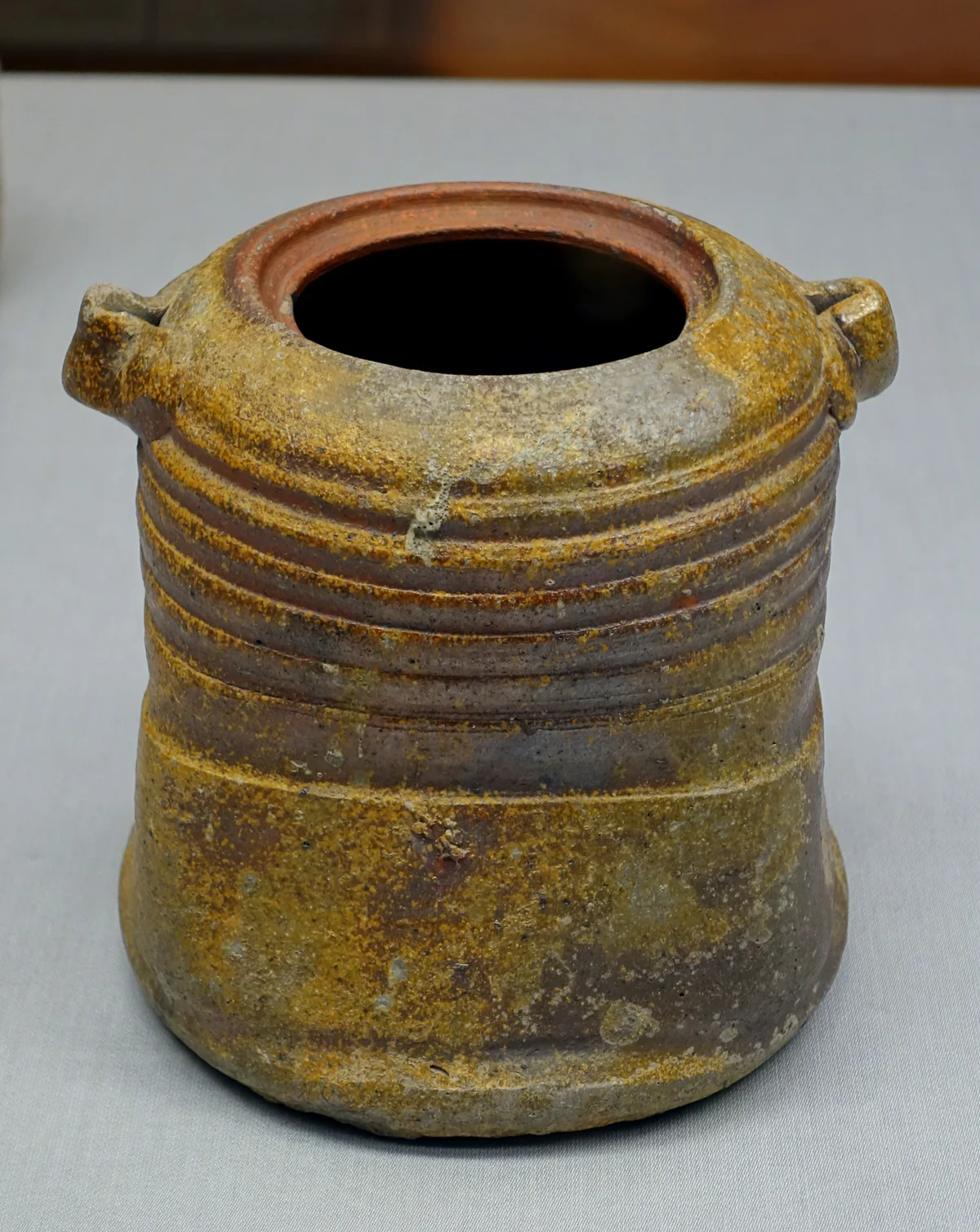
- Lead image: Tatsutagawa, a Bizen water jar, Tokyo National Museum. Photograph by Daderot, Wikimedia Commons, CC0 1.0. Resized for the web.
